Thermal Energy Storage
Canada has enormous potential for sustainable thermal energy storage/extraction that is broadly distributed across the country. For instance, Canada’s west coast forms part of the Pacific Ring of Fire, which has promising resource for developing a sustainable electrical generation. Despite having an abundant potential, the fundamental R&D and the utilization of these energy-related technologies are scarce.
Ground-coupled geothermal energy systems are typically used to augment the heating and cooling loads for residential, agricultural, or industrial applications. The hot or coolth energy is stored in the Earth’s vast-volume, high-pressure subterranean to be used later. In certain circumstances, the system could be located next to a large water body (river or lake) or near an aquifer, which make them subject to a high-pressure groundwater flow that could sweep away most of the stored energy. Here, we re-evaluate the design of the conventional ground-coupled geothermal energy systems and propose novel concepts of selective ground freezing to sustain the stored energy and improve the overall system efficiency. The idea is to create an impervious frozen barrier that suspends the groundwater flow.
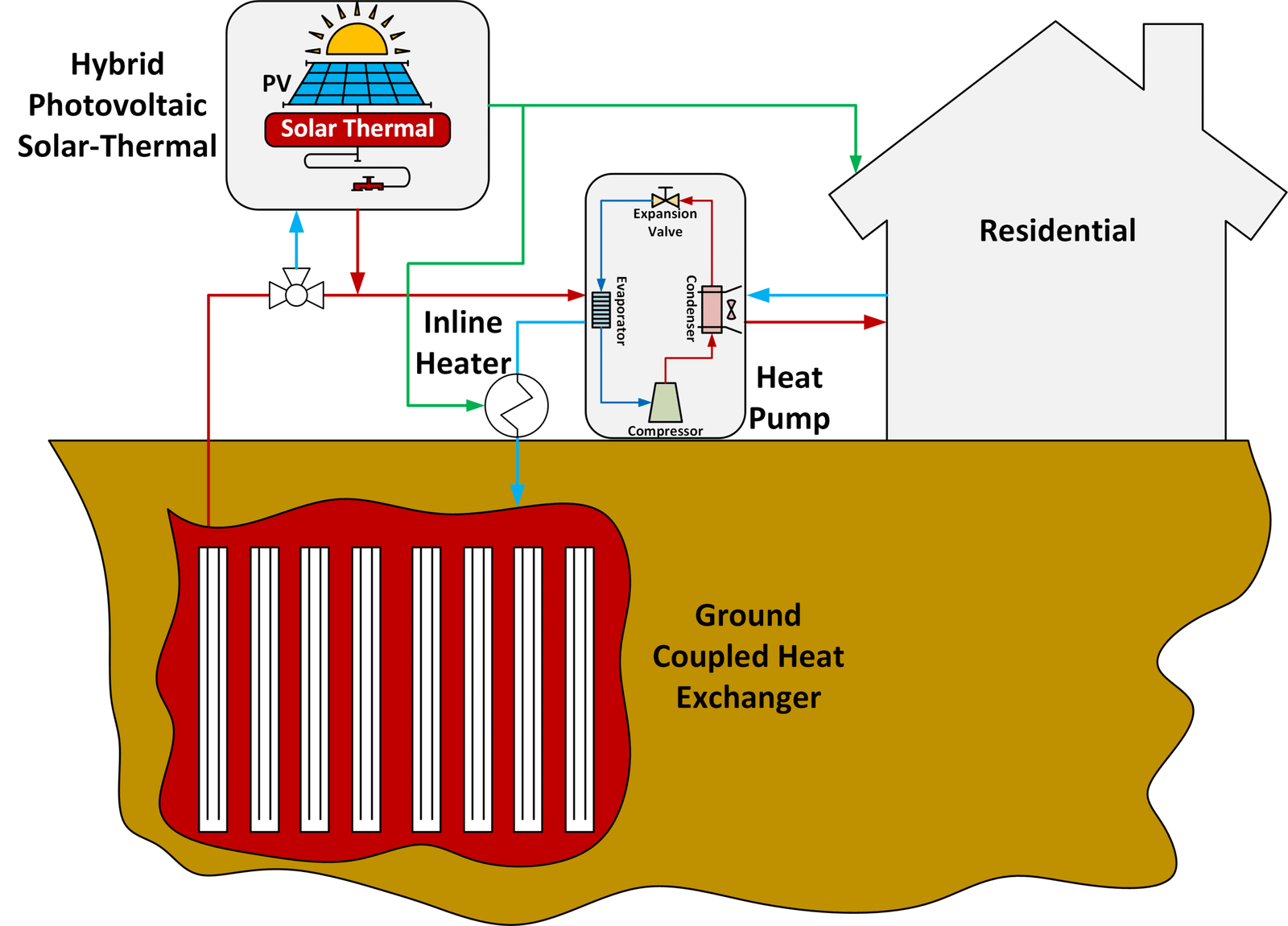
A hybrid geothermal energy storage and heating system integrating photovoltaic–solar thermal collectors with a ground-coupled heat exchanger.